14th Century CE
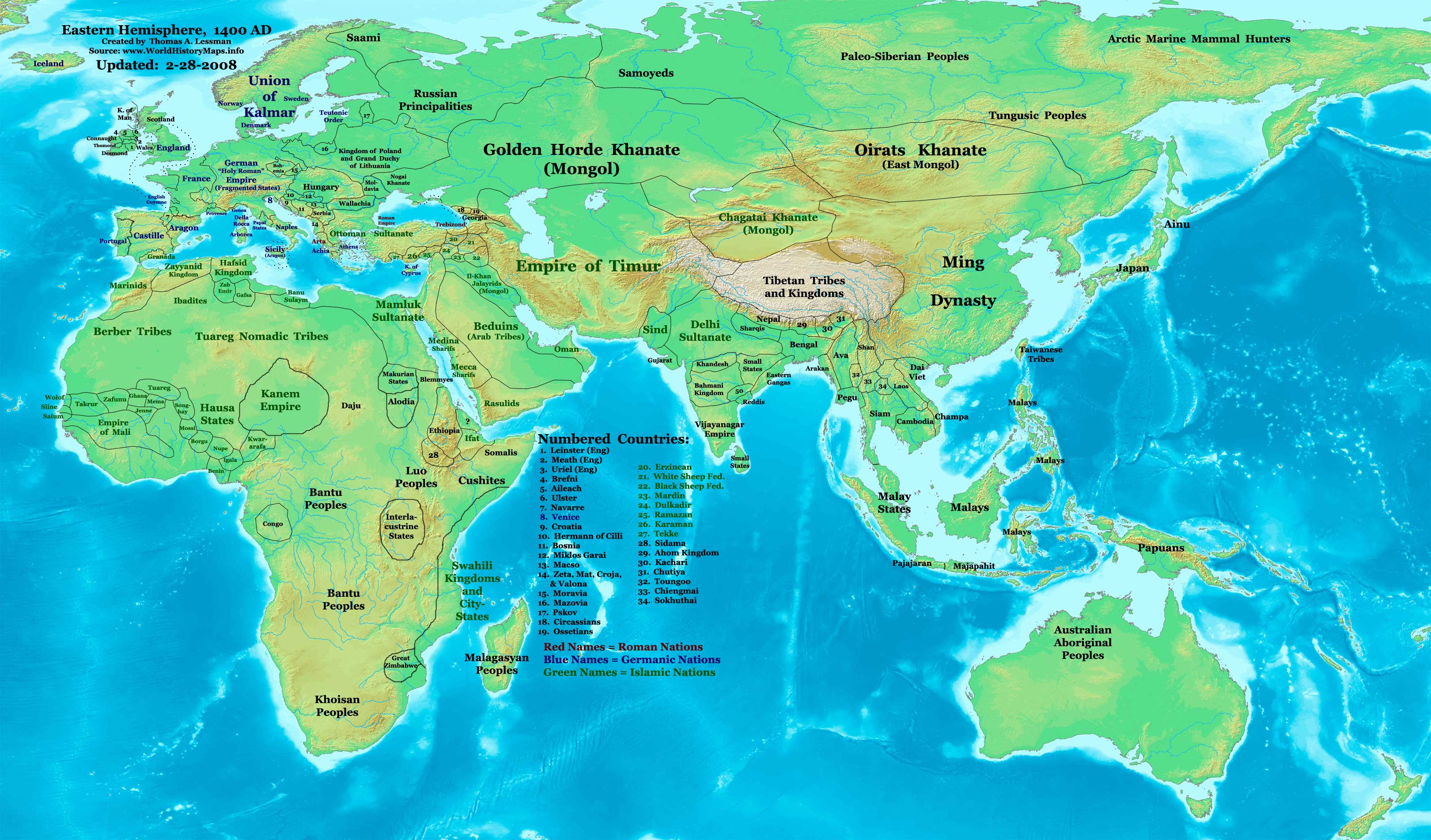
The 14th century was a time of devastating crisis across Eurasia, characterized by the Black Death pandemic, the Great Famine, the Hundred Years' War, and a major schism in the Catholic Church.
- Major Events
- The Great Famine (1315–1317 CE), triggered by the Little Ice Age, causes widespread death.
- The Hundred Years' War between England and France begins (1337 CE).
- The Black Death (Bubonic Plague) pandemic sweeps across Eurasia (1347–1351 CE), killing an estimated 75–200 million people.
- The Ming Dynasty is founded in China (1368 CE), overthrowing the Yuan (Mongol) Dynasty.
- Major Empires
- Ming Dynasty (China)
- Ottoman Empire (Rises in Anatolia and the Balkans)
- Delhi Sultanate (India)
- Timurid Empire (Founded by Timur, late century)
- Major Conflicts
- Hundred Years' War (Battle of Crécy, 1346 CE)
- Timur's military campaigns across Central Asia and Persia.
- Peasants' Revolt in England (1381 CE) and similar uprisings across Europe.
- Population Trends
- Catastrophic population decline across Europe, Middle East, and parts of Asia due to the Black Death.
- Severe labor shortages lead to higher wages and social changes in post-plague Europe.
- Key Leaders
- Zhu Yuanzhang (Hongwu Emperor, founder of the Ming Dynasty)
- Timur (Tamerlane, founder of the Timurid Empire)
- Charles V (King of France)
- Key Intellectuals
- Ibn Khaldun (Arab historian and sociologist, wrote the Muqaddimah)
- Geoffrey Chaucer (English poet, wrote The Canterbury Tales)
- Petrarch (Italian scholar, often considered the founder of Humanism)
- Major Religions
- Christianity (The Western Schism 1378–1417 CE, with multiple rival popes).
- Islam (Sufism gains prominence; spread continues in Africa and Southeast Asia).
- Ming Dynasty re-establishes Confucianism as the dominant ideology in China.
- Key Developments
- Start of the Italian Renaissance (pre-Black Death).
- The rise of centralized, bureaucratic states (e.g., France and England).
- Cannons and gunpowder become significantly more prominent in warfare.