11th Century CE
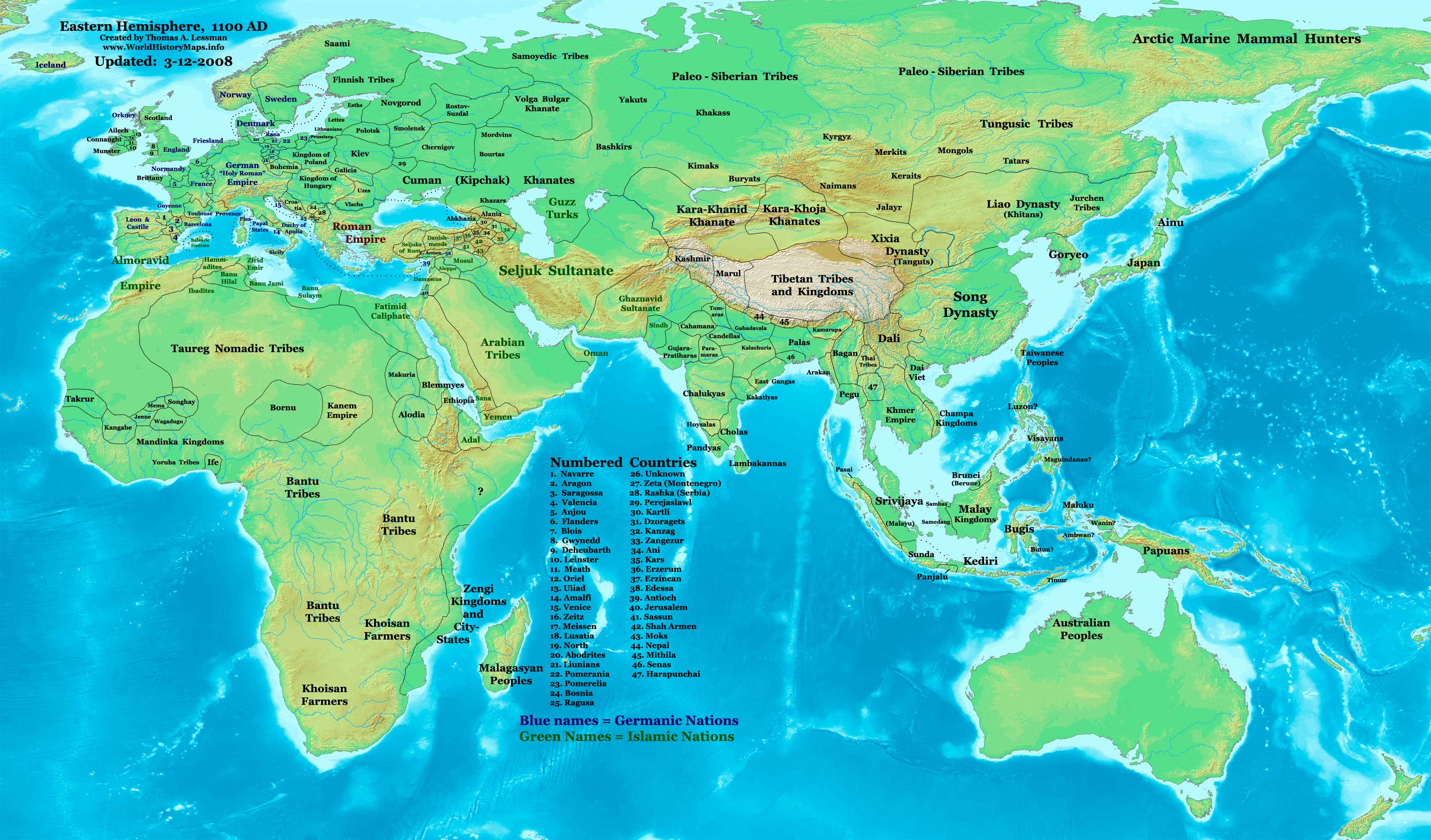
The 11th century was marked by the expansion of the Norman power, the formal schism between the Catholic and Orthodox Churches, and the launch of the first Christian Crusades to the Levant.
- Major Events
- The Great Schism (1054 CE): Formal split between the Roman Catholic and Eastern Orthodox Churches.
- Battle of Hastings and the Norman Conquest of England (1066 CE).
- The First Crusade begins (1095–1099 CE), leading to the capture of Jerusalem.
- Seljuk Turks defeat the Byzantines at the Battle of Manzikert (1071 CE), opening Anatolia to Turkish settlement.
- Major Empires
- Byzantine Empire (Under pressure from Seljuks and Normans)
- Holy Roman Empire (Struggles with the Papacy)
- Seljuk Empire (Controls much of the Middle East)
- Song Dynasty (China)
- Major Conflicts
- Battle of Hastings (1066 CE)
- Battle of Manzikert (1071 CE)
- First Crusade (1095–1099 CE)
- Population Trends
- Significant population increase in Western Europe, enabled by agricultural improvements.
- Expansion of population centers along trade routes like the Silk Road.
- Key Leaders
- William the Conqueror (Duke of Normandy, King of England)
- Pope Urban II (Called for the First Crusade)
- Alexios I Komnenos (Byzantine Emperor)
- Key Intellectuals
- Avicenna (Islamic polymath, died 1037 CE, wrote The Canon of Medicine)
- Anselm of Canterbury (Theologian and philosopher)
- Simeon the New Theologian (Eastern Orthodox mystic)
- Major Religions
- Christianity (Splits into Eastern Orthodox and Roman Catholic Churches).
- Islam (Shi'a Fatimids control Egypt; Sunni Seljuks dominate the East).
- Buddhism (Continues its slow spread across Asia).
- Key Developments
- Construction of Romanesque architecture across Europe.
- Development of feudalism into a more structured system in Western Europe.
- Rise of the Chola Dynasty as a major naval power in South India.